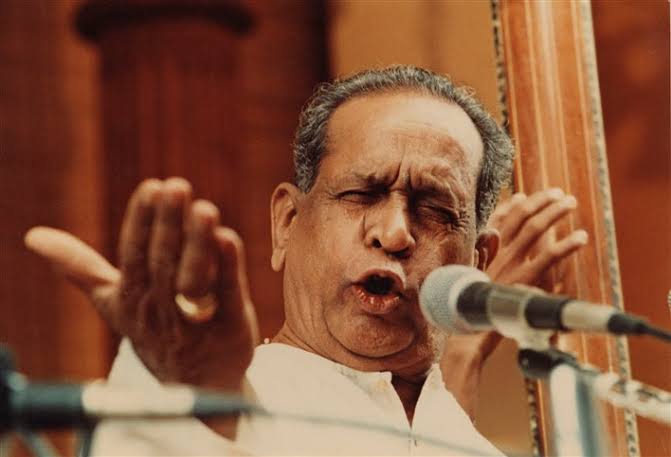
It was early November of 2008. Diwali had been celebrated in the last week of October. But the festivities returned once again at Pune’s Lakshmi Park Colony with rangolis and floral decorations adorning the road leading to ‘Kalashree’ the residence of Pandit Bhimsen Joshi, the doyen of Hindustani Classical Music.
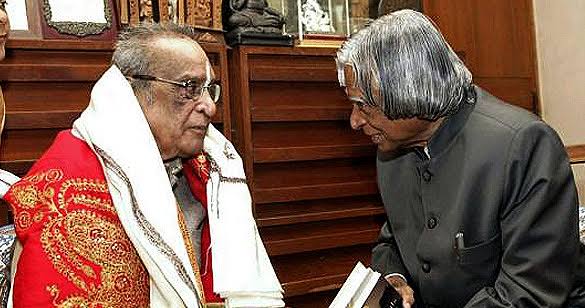
The rangolis were drawn by a civil society organization Vidhayak and had inscriptions ‘Mile Sur Hamara Tumhara’. This was the way music lovers of Pune greeted, when an announcement was made by the Rashtrapati Bhawan, about Pandit Bhimsen Joshi being conferred the ‘Bharat Ratna’ – the highest civilian award in the country.
Today, 4th February marks the birth centenary of the legendary artiste, an exponent of the Kirana Gharana, who was known for his mellifluous voice, dazzling taans and an incredible breath control.
Noted philosopher, Jiddu Krishnamurthy had once remarked “love is a like a river, endlessly moving on, ever seeking, exploring and pushing”. Similarly Bhimsen Joshi’s music was also like a river, ever exploring, ever inventing, to a create a unique vocal idiom.
Born in a conservative family of a school teacher at Ron near Gadag town of the erstwhile Dharwad district in Karnataka in 1922, Bhimsen Joshi was the eldest among 16 siblings. He showed inclination towards music early in his childhood, often wandering around following processions with music bands.
According to the family folklore, Bhimsen would often be seen standing in front of a music shop in the main street of Gadag, listening to ‘Fagwa Brij Dekhan Ko’, a Raag Basant composition rendered by Ustad Abdul Karim Khan, the founder of the Kirana Gharana.
Dharwad was then part of the Bombay State and the prevalent form of music was Hindustani. Bhimsen Joshi was fascinated by the Khayal form of singing. In those days, Khayal was principally taught in the Guru-Shishya Parampara.
In 1933, the 11 year old Bhimsen left home on his own in search of a Guru. Travelling ticketless through Bijapur, Pune etc, he reached Gwalior and joined the Madhav Sangeet Vidyalaya.
For a brief period, Bhimsen Joshi was the disciple of Ustad Hafiz Ali Khan, the most prized musician of Gwalior and father of Ustad Amjad Ali Khan, who taught him rudiments of Raag Puriya and Raag Marwa.
Bhimsen Joshi spent the next three years in Lucknow, Rampur, Jalandhar and Calcutta (now Kolkata).
Ultimately, his father Gururajrao Joshi succeeded in tracking him down and brought young Bhimsen back home.
In 1936, Rambhau Kundgolkar, better known as Sawai Gandharva, agreed to take Bhimsen Joshi as his disciple and imparted rigorous music training for four years.
The Guru taught him the nuances of Khayal Gayaki and the Shishya perfected the patterns of Raag Multani and Raag Todi, while performing errands at his Master’s house.
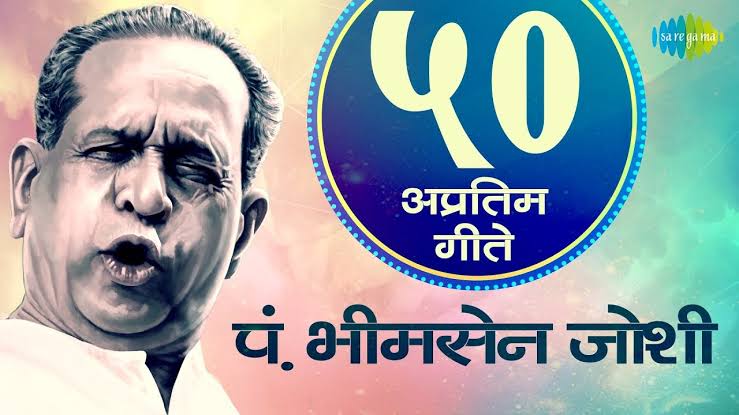
At the age of 20, Bhimsen Joshi released his first album, which was a collection of devotional songs in Hindi and Kannada.
His first live performance was held in Pune, at a concert to mark the Shashtabdipoorti (60 years) of his Guru Sawai Gandharva. He never looked back since then.
Making Pune his Karmabhoomi, he composed music for several Marathi plays during 1960s. His bhajans, especially the ‘Santawani’ program comprising abhangs of saints Dnyaneshwar, Tukaram and Namdev, became immensely popular.
Kannada audience got the taste of Joshi’s talent, when he rendered Jnanpeeth Awardee D.R.Bendre’s ‘Uttara Dhruva Dim, Dakshina Dhruva Ku’ for HMV. His rendition of Purandara Dasa’s ‘Bhagyada Lakshmi Baaramma’ – invoking Goddess Lakshmi, is still among the most favourite devotional songs in Kannada.
He bought a huge car to travel around. Bombay to Belgaum to Solapur to Hyderabad to Nagpur, the journeys continued unending.
The spread of his fame and popularity beyond the boundaries of Karnataka and Maharashtra, soon brought him invitations from far off places.
He soon realized the car had its limitations – it moved in a vilambit taal.
So Panditji switched to air travel, to which his friends remarked “the disciple of Sawai Gandharva has become ‘Hawai’ Gandharva”.
Joshi toured Afghanistan, Italy, France, Canada and the USA and held immensely popular music concerts.
Dutch filmmaker M Louis made bio-pic on Bhimsen Joshi and showed it to the Western world.
Bhimsen Joshi’s rendition of ‘Mile Sur Mera Tumhara’ along with other doyens of Indian music, virtually became the unofficial anthem in the late 1980s, capturing the hearts of millions of Indians.
For over four decades, Bhimsen Joshi led the renaissance of Indian Classical music with passion and power. His seemingly effortless performances often hid hours of relentless riyaz.
Panditji had once remarked “an unsympathetic teacher and rigorous riyaz with a bit of luck thrown in makes anyone a good singer”. Fortunately or unfortunately, Joshi had all three of them.
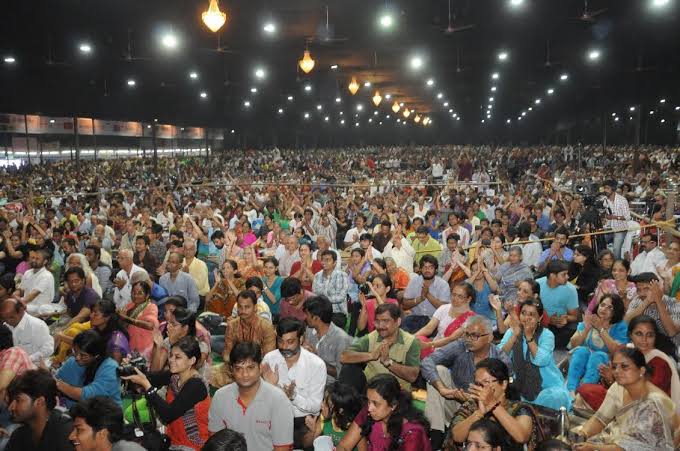
But his gratitude to his Gurus always remained rock solid as evidenced by the immensely popular Sawai Gandharva Mahotsav he started in Pune. This music festival has become a kind of annual pilgrimage for Hindustani Classical music lovers all over the world.
With achievements so tall, honours and awards came his way. Padma Shri in 1972, Sangeet Natak Akademi Award in 1975, Padma Bhushan in 1985, Padma Vibhushan (1999), Tansen Samman in 2002 and the Bharat Ratna in 2007-08.
The state Governments of Maharashtra and Karnataka honoured him with Maharashtra Bhushan in 2002 and Karnataka Ratna in 2005 respectively.
The Akashvani Sangeet Sammelan is now named after him.
In his life time, Bhimsen Joshi took the Kirana Gharan to new heights. The Swarbhaskar is no more, but his voice will always be with us.
(This is an updated version of my 2008 article, written when the Bharat Ratna award was announced. – Manish Desai).
MD / BPost / XV.

 ON THIS DAY